B-17 Nine-O-Nine

Sep 292012
 

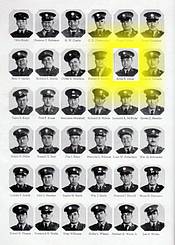
On CourseHere’s something interesting from On Course!, class 45-14B at the San Angelo Army Air Field.  This class trained at least fifteen black cadets to be bombardiers.  Assigned to Flight 6, they are pictured along with their Bomb-a-dears (wives, sweethearts and children) starting on page 57.

That they are pictured at all, especially with their family members, shows the base was somewhat ahead of its time.  They were still segregated, but they appear in the book like any other cadets.  A cartoon on page 67 emphasizes the situation.  It’s humorous, but still not quite right.

Continue reading »

Sep 292012
 

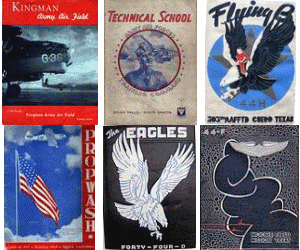
Shack 43-16You can now browse the collection by class or unit number.  Suppose you know a relative who was in class 44-D, but you’re not sure at which air field he or she was stationed.  You can display the items associated with all classes that were numbered 44-D.  This narrows down the book in which your relative might appear.

Each of several air fields had a class 44-D, but these were all separate and unrelated class groups.  For example, class 44-D at one field may have been a primary pilot class, while at another field 44-D was an advanced pilot class.

To browse by class or unit, follow these steps.

Continue reading »

Sep 062012
 
Frederic N. Hernandez

Frederic N. Hernandez
June 6, 1943

Please visit an excellent website, A Tribute to Frederic N. Hernandez, created by Michael Hernandez, the grandson of this decorated World War II Army Air Forces veteran.

2nd Lt. Hernandez served in the 10th Air Force, 7th Bombardment Group, 308th Bombardment Squadron (Heavy).  The site has many fascinating mementos and historical artifacts to see.

Continue reading »

Aug 262012
 
Jack H. Gardner

Jack H. Gardner
circa 1943

There’s something new at the AAF Collection: The Jack H. Gardner Collection. Lt. Jack Gardner enlisted in the Army Air Corps in January 1940 and served until December 1945. He was in the Air Transport Command, and flew all types of aircraft, passengers and cargo throughout the United States and the Pacific Theater. He even flew several secret missions.

Lt. Gardner had a fascinating career in the Army Air Forces during World War II.  His son Bronson Gardner has scanned his father’s collection of service records and papers, and he has graciously contributed them all to the AAF Collection.

This will be an interesting study of one airman’s personal story, as told through vintage photographs, certificates, army orders and paperwork.  A few of these items are available to view now.  I will be adding more items from his collection in the coming weeks.  In the meantime, you can take advantage of the new Collections feature to view the collection.

Continue reading »

Aug 262012
 

CollectionsI added a new feature I call Collections to the site. These are groups of various and different items that are related in some way.  For instance, a Collection can contain all the items contributed from one veteran’s collection. So even though items have different subject matter or come from different air fields, they are still grouped together as a collection.

While you view the list of items, you’ll see a View Collection indication on some items. This means an item is part of a collection.  Click it to view a list of all items in the collection.

You can also browse the collections available. Choose Browse the Collection in the Choose an Action drop-down box.  Then choose Collections in the Browse drop-down box.  You’ll then be able to select one of the available collections.  More collections will be added.

Or, choose Summarize under Choose an Action, then Collections to see more information about each collection.

The Collections feature within the AAF Collection is yet another way to view relationships between items. It may lead you to some interesting discoveries.

Nov 152011
 

View a copy of The Gig SheetThe seventieth anniversary of the Japanese attack on Pearl Harbor is this year.  I found a poignant reminder of that tragedy in an item recently added to the AAF Collection.

The Gig Sheet is a class book for advanced pilot training at Kelly Field, Texas.  Class 41-F graduated on August 15, 1941 just three months before the United States entered the war.

Continue reading »

Oct 242011
 

Thieme Crew

I encourage you to visit the Gilbert Malrait and Thieme Crew memorial site at www.2ltmalrait-gilbert.net. It gives an account of a B-24 combat air crew, most of whom were killed in action on April 4, 1944. What makes this site unique is the background and personal history of each crew member. There are lots of photographs and documentation.

Continue reading »

Sep 012011
 

When I started the AAF Collection I was confused over the terms Army Air Corps versus Army Air Forces.  My father often spoke of his service in the Air Corps, but the material I found all seemed to refer to the Air Forces.  I researched the question and uncovered the following history of the Army Air Forces.

Airplanes were a small part of the Signal Corps at the close of World War I. In that war, they were used chiefly for aerial reconnaissance in support of ground troops. A total of 600 American airmen were killed and 340 planes lost. US planes dropped only 138 tons of bombs.1

Continue reading »

Citations

  1. Geoffrey Perret, Winged Victory: The Army Air Forces in World War II. New York: Random House, 1993, pp. 5 and 7. []
Sep 012011
 
Clyde O. Primrose, Jr.

Clyde O. Primrose, Jr.

Clyde O. Primrose, Jr.
(1923-1944)

Clyde Odis Primrose, Jr. was a young lad of 19 when he entered the United States Army in 1942. He had grown up on a farm near Hemphill, Texas, the oldest of what would eventually be eleven children his mother and father would rear. The family had no electricity or running water, but they had each other and a wonderful work ethic. From the first time he saw an airplane in the sky as a young child, he wanted to fly. As did thousands of others, Odis answered his nation’s call and joined the Army, with only a dream that he could somehow make it through cadet training, mechanics training, flight school, and advanced training and become a pilot. By sheer hard work and determination, he competed with college educated men, and did indeed become a flight cadet, earn his wings, and eventually see service as a co-pilot on a B-24 heavy bomber.

Continue reading »